

High Quality Crash Barrier Corrugated W Beam Guardrail for Sale


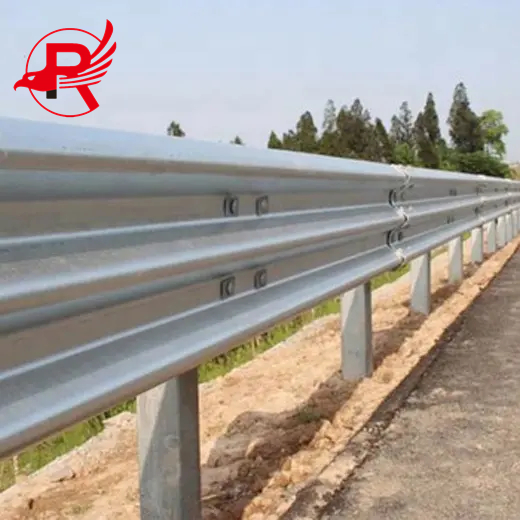
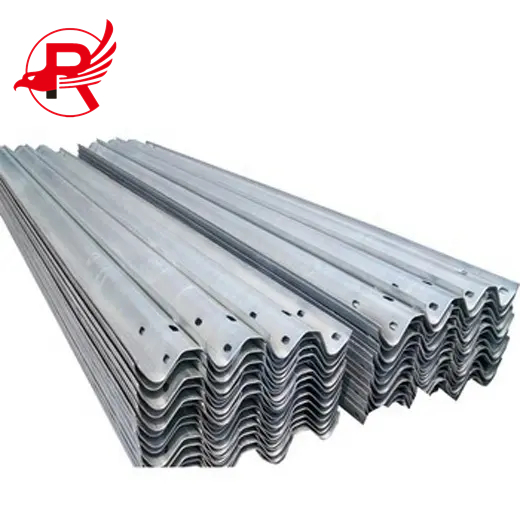


| Attribute | Technical Specifications |
| Product Name | Corrugated W-Beam Guardrail / Highway Crash Barrier |
| Base Material | Carbon Steel (Q235B, Q355B, ASTM A36, S235JR, S355JR) |
| Standard | AASHTO M180 (Class A/B), EN 1317, JT/T 281-2007 |
| Profile Shape | W-Beam (2-Wave); Thrie-Beam (3-Wave) available |
| Base Metal Thickness | 2.67mm / 3.0mm / 3.43mm / 4.0mm (Customizable) |
| Effective Length | 3810mm / 4000mm / 4320mm |
| Width | 310mm / 312mm |
| Wave Height | 83mm / 85mm |
| Surface Treatment | Hot Dipped Galvanized (HDG) / PVC Powder Coated |
| Zinc Coating Weight | 550 g/m² (79µm) / 1100 g/m² (158µm) / 1200 g/m² |
| Tensile Strength | ≥ 410 MPa (Standard) / ≥ 520 MPa (High Strength) |
| Yield Strength | ≥ 245 MPa / ≥ 345 MPa |
| Elongation | ≥ 18% - 23% |
| Application | Highway, Bridge, Rural Road, Parking Lot, Industrial Zone |
| Component | Common Specifications / Features |
| Guardrail Post | C-Post, U-Post, Sigma Post, Round Post, H-Post |
| Spacer / Blockout | U-Channel, C-Channel, or customized steel blocks |
| End Terminals | Fishtail, Bullnose, or Buffered End Sections |
| Bolts & Nuts | M1635, M1645, M16*170 (High Strength Grade 8.8) |
| Reflectors | Delineators (Trapezoidal or Round) in Yellow/White/Red |
metal barrier have a wide variety of applications, including:
1. Security
Metal barriers deliver robust physical protection for properties and effectively block unauthorized access to restricted zones. They are widely deployed in high-security sites including airports, government establishments, and military facilities.
2. Vehicle Control
Metal barrier systems including bollards, guardrails, and access gates help standardize vehicle flow and reduce collision risks. These solutions are extensively applied in parking lots, toll stations, and construction zones.


Note:
1.Free sampling, 100% after-sales quality assurance, Support any payment method;
2.All other specifications of round carbon steel pipes are available according to your requirement (OEM&ODM)! Factory price you will get from ROYAL GROUP.
The process of steel road barrier involves several steps. Here is an overview of the general process:
1. Raw Material
High-strength Steel Coils (Q235B/Q355B).
De-coiling and leveling to ensure flatness.
2. Precision Punching
CNC Automated Punching for bolt holes and slots.
Ensures 100% alignment during site installation.
3. Cold Roll Forming
Steel passes through multi-stage rollers to form the "W" profile.
This shape provides the mechanical strength for impact absorption.
4. Cutting
Hydraulic cutting to standard lengths (e.g., 4.32m or 3.81m).
5. Surface Treatment (Protection)
Hot-Dipped Galvanizing: Submerged in 450°C molten zinc for superior anti-corrosion.
Optional Coating: Electrostatic powder coating (Green/Blue/White) for extra durability.
6. Inspection & Loading
Testing zinc thickness (min. 79μm) and mechanical properties.
Bundling for international sea freight.
Overall, the process of manufacturing a metal barrier is a complex process involving many different steps that requires skilled workers with specialized knowledge and equipment.
Packaging is generally naked, steel wire binding, very strong.
If you have special requirements, you can use rust proof packaging, and more beautiful.

Transportation: Express (Sample Delivery), Air, Rail, Land, Sea shipping (FCL or LCL or Bulk)

Q1: What is the standard length of a W-Beam guardrail?
A: The standard effective length is typically 3.81m (12.5 ft) or 4.32m. However, custom lengths can be manufactured to match specific post spacing requirements.
Q2: What is the difference between Class A and Class B guardrails?
A: This refers to the steel thickness according to AASHTO M180:
Class A: Base metal nominal thickness of 2.67mm (12 Gauge).
Class B: Base metal nominal thickness of 3.43mm (10 Gauge).
Q3: How long does the galvanizing last?
A: Hot-dipped galvanizing (with a standard 550g/m² or 79μm coating) typically provides a service life of 20–50 years, depending on the corrosivity of the environment (coastal vs. inland).
Q4: Can W-Beam guardrails be used on curves?
A: Yes. For curves with a radius of less than 45 meters, the guardrails must be shop-curved (pre-bent in the factory) to ensure a precise fit and structural integrity.
Q5: What are the standard post types used for installation?
A: The most common are C-Posts, U-Posts, Sigma Posts, and H-Posts. The choice depends on the soil conditions and the specific highway safety standard of the region.
Q6: Do I need a spacer (blockout) between the post and the rail?
A: Yes. Spacers reduce the "wheel snagging" effect during a collision, preventing the vehicle's tires from hitting the posts, which helps maintain the vehicle's stability.
Q7: How are the rails connected?
A: They are overlapped in the direction of traffic flow and secured using 8 to 12 sets of M16 high-strength splice bolts.


